
Season aired: Winter 2025
Number of episodes: 13
Watched on: Netflix
No products found.
Translated by: Aya Kudo
Genres: Romance, Drama, Supernatural
Thoughts: My Happy Marriage returns with a second season on Netflix. Despite facing production issues that led to the delay of the last two episodes, it successfully conveys the story in a concise manner. I was thrilled to revisit the romance between Miyo and Kudo, which remains one of the highlights of the anime.
Miyo Saimori is a girl mistreated within a noble family. In this world, all noble families possess supernatural powers, yet Miyo appears to exhibit none. After being sold into a marriage with the cold but remarkable Kiyoka Kudo, Miyo uncovers hidden truths about her family, herself, and Japan’s political environment, as an unexpected romance flourishes between her and the man believed incapable of loving another.
While the first season centers around Miyo and her connection with Kudo, this season delves deeply into the supernatural, focusing on Miyo’s Dreamsight power and her struggle to control it. Having grown more self-assured in her position next to Kudo, Miyo begins the season exuding greater confidence, making her a more proactive participant in the narrative compared to the first season. This development was vital. In the first season, viewers could empathize with her difficult past and were inclined to accept her passive role as a handsome knight like Kudo came to save her. However, now that she has been rescued, it would detract from overall storytelling and character development for her not to evolve throughout the second season.
No products found.
 A different Miyo
However, the series’ approach to showcasing her active role is subject to debate. For much of the season, I believe it is effective. Miyo finds opportunities to assist Kudo in reconnecting with his stubborn and critical mother, and expresses her intent to use her powers to help those in need. She even becomes a hero to her first friend by defending Kaoruko, who consistently faces sexism from her male colleagues as the sole female in the military. Miyo’s significant shortcoming lies in her lack of understanding and command over her abilities, something that the antagonists seek to exploit for their own purposes. This renders her ineffective in physical confrontations, and while this isn’t logically a flaw, knowing she possesses untapped potential can be frustrating to witness. With this season being considerably more action-packed, her helplessness in the background becomes increasingly annoying to observe.
The primary critique is that after Miyo fully comprehends her abilities, she only showcases them to their fullest in one episode. During this episode, she takes initiative in the plans, steps forward to wield her powers, and successfully subdues foes. However, upon reuniting with Kudo, she again retreats, allowing her fiancé to take the spotlight. While the finale grants her a brief opportunity to shine, it mostly consists of her attempting to persuade the villain to surrender verbally, which isn’t even the pivotal factor in his defeat. This doesn’t negate all the proactive measures she undertook earlier in the series, but to see her climactic moment rely more on dialogue than action leaves a disappointing impression.
 Dynamic action sequences
The positive aspect is that while I wished Kudo would occasionally take a step back to allow Miyo to excel in battle, his fight scenes are incredibly dynamic and well-animated. Kudo may appear overpowered with his ability to unleash diverse elemental attacks, but the villains he confronts are often those he must capture alive for the government, necessitating him to restrain his full power. Consequently, his battles are engagingly choreographed, enabling him to display not just his supernatural skills but also his sword proficiency. He glides across the screen, looking for openings to incapacitate an opponent instead of summoning a lethal blast of lightning.
This season also features a substantial amount of political intrigue, only briefly touched upon in the first. Given the significant implications of the Taisho era, which ultimately paved the way for the more famous Meiji era and the World Wars, I was pleasantly surprised by the incorporation of historical references. One character possesses the supernatural power to glimpse the future and mentions the nation’s need to either avert imminent disasters or prepare for them—an apparent nod to the World Wars that would later devastate Japan.
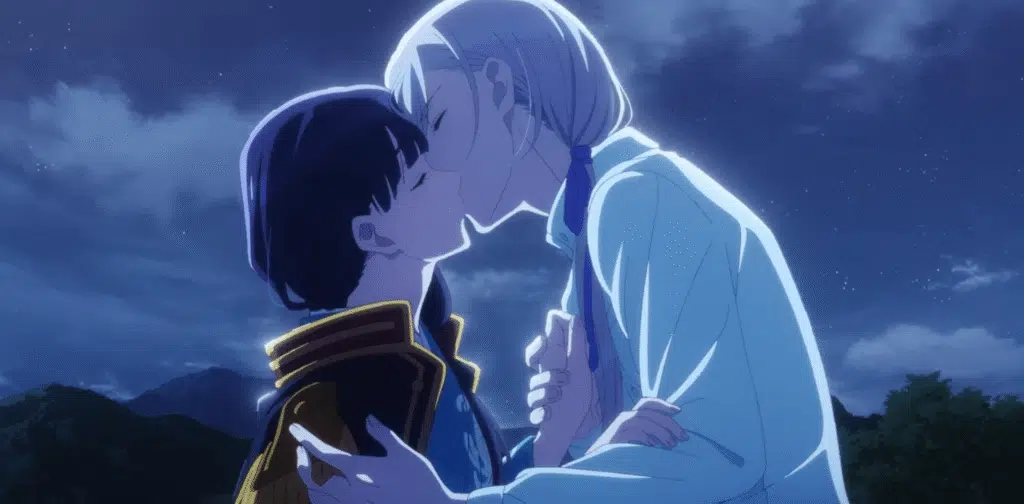
The anime’s true highlight is the relationship between Kudo and Miyo. The first season successfully established their chemistry and burgeoning love, prompting many viewers, myself included, to yearn for additional romantic moments in the second season filled with plot and conflict. This anticipation makes their final resolution in the finale all the more satisfying and deserved, as the two finally have a chance to reconnect and share some leisurely moments exploring the town, shopping, and enjoying the sunset.
 Top Tier Romance
The series recognizes that its strongest asset remains the romance, and it effectively employs the soundtrack to enhance this aspect. Evan Call, celebrated for his remarkable work in Frieren: Beyond Journey’s End, has a unique talent for aligning his sound with the series’ tone. In My Happy Marriage, I could detect similarities between his compositions for this show and his previous work on Frieren. During the most romantic scenes, the violin and melodic lines emerge, evoking a soft, comforting atmosphere. Unlike instances where I found similar music by soundtrack composers detrimental, I viewed this repetition positively in this particular context. Amidst all the tense, life-threatening situations surrounding them, Miyo and Kudo can only truly discover tranquility in each other’s presence, a feeling beautifully expressed through a specific blend of notes and instruments that Evan Call has crafted.
I’m thrilled that My Happy Marriage continues its journey. Across seasons one and two, Kudo and Miyo were technically never married. As the second season concludes, with both Miyo and Kudo realizing their wishes and planning to dedicate their lives to one another, the series title may at last become a reality. While I had some reservations regarding the use of Miyo’s powers towards the end, I’m not so harsh that a single misstep would taint the overall feelings the series evoked in me. This second season is filled with political intrigue, dynamic supernatural battles, and captivating relationships, both romantic and platonic, which likely positions it as the superior season.
Rating
Plot: 8 (Multiplier 3)
Characters: 7.5 (Multiplier 3)
Art/Animation: 7.5 (Multiplier 2)
Voice acting: 8
Soundtrack: 8.5
FINAL SCORE: 78

