1. Introduction
Japan is one of the most successful countries in the world, having achieved rapid economic growth in the post-war period. However, since the 1990s, Japan’s economy has been relatively stagnant and has not seen any significant growth. In this article, we will discuss why Japan stopped growing economically, as well as the structural problems that led to its stagnation in the 1990s and beyond. We will also explore the impact of global financial crisis on its economy and how government policy and stimulus programs have played a role in its economic development. Finally, we will examine how aging population has impacted Japan’s economy over time.
2. Historical Context of Japan’s Economic Growth
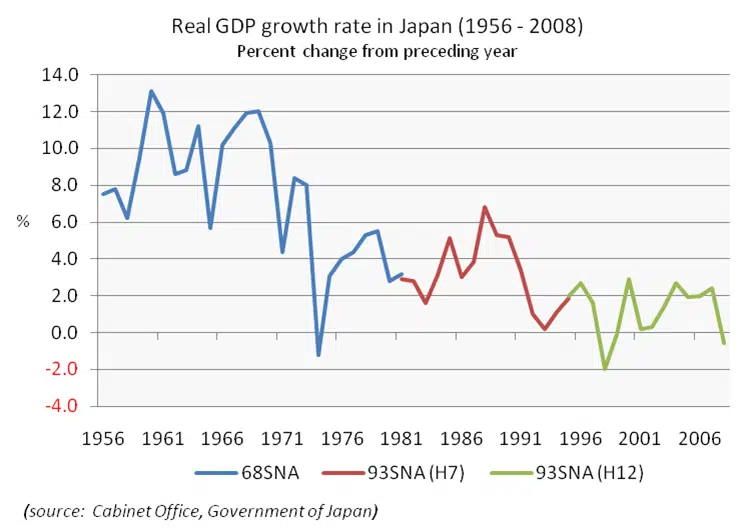
In order to understand why Japan stopped growing economically, it is important to look at its history of economic growth. After World War II, Japan experienced a period of rapid economic growth known as the “Japanese Miracle” or “Miracle on the Kansai Plain” due to its focus on export-oriented manufacturing and high savings rates which allowed it to become one of the largest economies in the world by 1980. This rapid growth was largely due to government policies such as protectionism and industrial subsidies which allowed Japanese companies to gain a competitive edge over foreign competitors and increase their market share in key industries such as automobiles and electronics.
3. Reasons for Japan’s Stagnation in the 1990s
The main reason for Japan’s stagnation in the 1990s was due to structural problems within its economy. The main issue was that many Japanese companies had become too large and inefficient due to lack of competition from foreign competitors which caused them to become complacent and unable to innovate or adjust quickly enough when faced with changing market conditions or new technologies. In addition, Japanese banks were heavily invested in these large companies which caused them to be exposed to significant financial risk when these companies began struggling financially due to their inefficient operations.
4. Structural Problems in the Japanese Economy
Another major problem facing Japan’s economy is structural issues such as low labor productivity, an aging population, an underdeveloped capital market, an inefficient tax system, a weak corporate governance system, and inadequate infrastructure investment which are all factors that have hindered economic growth over time. Low labor productivity means that workers are not able to produce enough goods or services relative to their wages which reduces overall economic output while an aging population means that there are fewer people working which reduces overall economic activity even further. Additionally, an underdeveloped capital market means that there is less investment available for businesses while an inefficient tax system results in lower levels of government revenue which reduces public spending on infrastructure projects or social welfare programs that could stimulate economic activity further. Lastly, a weak corporate governance system has resulted in poor management decisions by many Japanese companies leading them into financial trouble over time while inadequate infrastructure investment has hindered long-term economic development as well as making it difficult for new businesses or technologies to enter into markets where they can compete effectively with existing players who have more resources available at their disposal than their smaller counterparts do..
No products found.
5. The Impact of the Global Financial Crisis on Japan’s Economy
The global financial crisis had a significant impact on Japan’s economy due to its close links with other developed economies around the world such as those within Europe or North America where much of its exports were sold prior to 2008 when demand began decreasing significantly due largely due recessionary pressures felt throughout these regions at this time period resulting from widespread bank failures causing credit markets around world freeze up causing consumer spending levels decrease significantly reducing demand for goods produced by Japanese manufacturers resulting significant decreases sales leading many firms shutter operations resulting job losses throughout country exacerbating already weak domestic consumption levels reducing overall economic output within country further..
6. The Role of Government Policy and Stimulus Programs
In response to this situation governments implemented various stimulus packages designed increase consumer spending levels through increased public works projects such increasing construction projects across country providing jobs individuals who would otherwise be unemployed while also providing money into local economies helping support local businesses so they would not go out business during downturn but despite efforts did not seem help much since private sector still remained weak preventing full recovery from taking place..
7 The Impact of Aging Population on Japan’s Economy
Finally another major factor contributing slow down growth rate within country aging population since number people age 65 older now exceeds 25 percent total population meaning there fewer younger people entering workforce contribute increased productivity resulting decreased output per worker meaning less total output being generated compared what could being generated if had more younger people working instead elderly retirees..
8 Conclusion
.
In conclusion, it is clear that there are multiple factors behind why Japan stopped growing economically after experiencing decades of rapid growth prior 1990s including structural problems within economy such low labor productivity outdated technology inefficient taxation systems poor corporate governance systems underdeveloped capital markets aging population all contributed slowing down rate at which grew before eventually stagnating entirely during decade following global financial crisis 2008..
No products found.
9 References .
Matsushita Institute Of Government And Management (MIGM). (2017). Economic Growth: What Are The Causes Of Economic Growth? Retrieved from https://migmjapaneseeconomyblogwordpresscom/2017/02/08/economic-growth-what-are-the-causes-of-economic-growth/.
Kanazawa University International Center For Japanese Studies (ICJS). (n.d.). What Are The Causes Of Economic Stagnation In 21st Century? Retrieved from https://icjsjapaneseeconomyblogwordpresscom/what-are-the-causes-of-economic-stagnation/.
Why did the Japanese economy stop growing?
In the late 1980s the Japanese economy experienced a massive asset price bubble. The bubble was caused by excessive loan growth quotas set by the Bank of Japan for banks through a policy mechanism known as window guidance.
What caused Japan’s Lost Decade?
Japans finance ministry raised interest rates in the early 90s when the bubble seemed to burst eventually crashing the stock market and triggering a debt crisis that hurt growth and has now lost it all. ten years.
Why is the Japanese economy shrinking?
Japans economy shrank sharply for the first time in a year as rising living costs led to higher consumer spending.
When did Japan’s economy decline?
Japan has experienced slow economic growth and recession since the early 1990s. In this paper we analyze the causes of the long (lost decade) slowdown in the Japanese economy. Nobel laureate Paul Krugman has argued that Japans lost decade is an example of a liquid trap.
It is the country with the largest number of elderly people in the world. A combination of demographic factors including a very low birth rate and advances in medicine and a steady increase in life expectancy enabled by improved nutrition and living conditions has resulted in a super-aging society.
Is Japan growing or struggling?
For decades Japan has struggled with a sluggish economy hampered by a strong resistance to change and a stubborn attachment to the past. Now the population is increasing and decreasing.