
1. Introduction
The question of whether or not Japan is allowed to have a military again has been a subject of debate for decades. After World War II, the Allied Powers imposed restrictions on Japan’s ability to maintain a military, and the Japanese Constitution was amended to renounce war and the threat or use of force as a means of settling international disputes. Since then, Japan has maintained a self-defense force and entered into an alliance with the United States, but there are still questions about whether or not it should be allowed to have a full-fledged military. In this article, we will explore the history of Japan’s post-WWII military, its current self-defense force, its role in international peacekeeping operations, public opinion on the issue of militarization, and arguments for and against allowing Japan to have a military again.
2. Japan’s Post-WWII Military History
After World War II ended in 1945, the Allied Powers imposed restrictions on Japan’s ability to maintain a military. The San Francisco Peace Treaty was signed in 1951 and officially ended the state of war between Japan and the Allied Powers. As part of this treaty, Article 9 of the Japanese Constitution was amended to renounce war and the threat or use of force as a means of settling international disputes. This amendment effectively prohibited Japan from having any type of standing army or navy other than for self-defense purposes.
3. The San Francisco Peace Treaty & the Japanese Constitution
The San Francisco Peace Treaty is an international agreement that officially ended World War II between Japan and Allied Powers such as the United States, United Kingdom, France and China. As part of this treaty, Article 9 was added to the Japanese Constitution which states that “the Japanese people forever renounce war as a sovereign right of the nation…and land, sea and air forces…will never be maintained.” This effectively prohibited Japan from having any type of standing army or navy other than for self-defense purposes.
4. Japan’s Modern Military & Self Defense Force
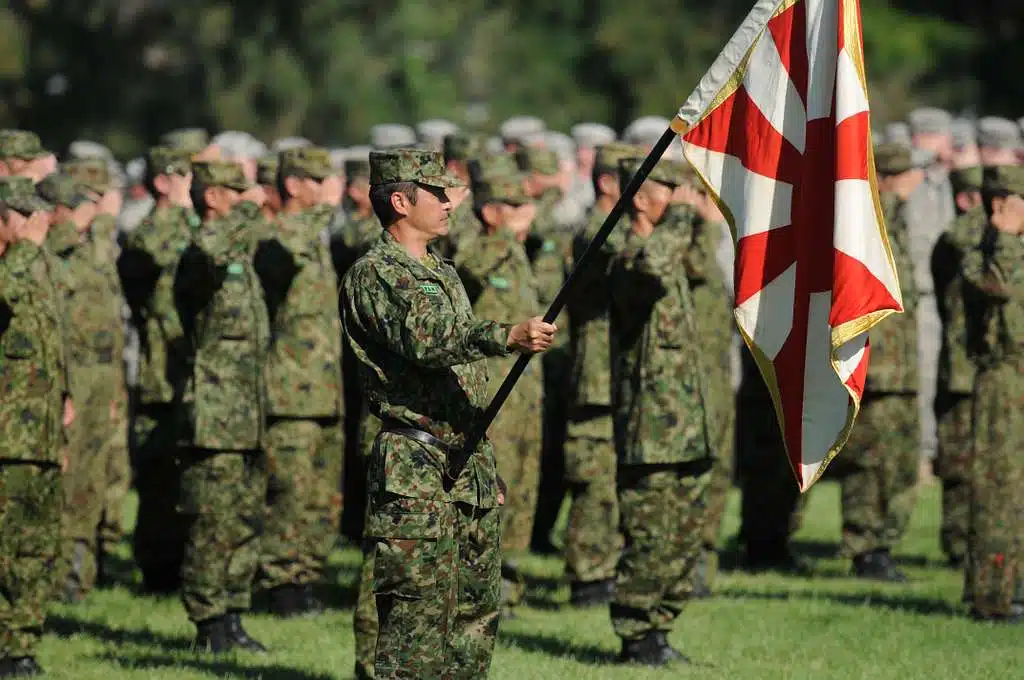
In 1954, following passage of Article 9 in 1951, Japan established its modern Self Defense Force (SDF). The SDF is limited in size compared to other militaries around the world but is equipped with some advanced weaponry such as fighter jets and naval vessels. The SDF is responsible for defending Japanese territory from external threats as well as providing humanitarian assistance during natural disasters such as earthquakes or tsunamis.
No products found.
5. US-Japan Security Alliance & Mutual Cooperation
Since 1951 when Article 9 was added to their constitution prohibiting them from having any type of standing army or navy other than for self defense purposes; Japan has had an alliance with US through mutual defense treaties since 1951 called “The US–Japan Security Alliance”. This alliance has provided stability in East Asia by deterring aggression by any foreign power against either country.Under this agreement both countries cooperate closely on matters such as intelligence sharing,joint exercises,technology transfers etc.
6. Japan’s Role in International Peacekeeping Operations
Despite not having a full fledged military,Japan has played an active role in international peacekeeping operations since 1992.The country has contributed personnel,financial resources,and equipment to UN peacekeeping missions throughout Asia,Africa,and Europe.In particular,Japan has provided personnel for de-mining efforts in Cambodia since 1992.In addition,the country provides financial support for UN missions operating in countries such as Sudan.
7. Public Opinion on the Issue of Japanese Militarization
Public opinion polls conducted over several decades indicate that most people in Japan are opposed to revising their constitution so they can have an official military again.A 2019 survey showed that only 17% supported revising Article 9 while 71% opposed it.However there were some generational differences among respondents with those aged 18–29 being more likely than those aged 50+ years old to support revising Article 9 so that they could have an official military again (27% vs 11%).
8 Arguments For and Against Allowing Japan To Have A Military Again
There are many arguments both for and against allowing Japan to have an official military again:
For: Supporters argue that it would give them greater autonomy from their ally -the United States –and allow them more flexibility when responding to regional security threats such as North Korea’s nuclear program.They also argue that it would make them more capable when participating in international peacekeeping operations.
No products found.
Against: Opponents argue that revising Article 9 would be seen by many countries around world –especially China –as hostile act which could destabilize regional security situation even further.They also point out that given current level economic inequality within society it might be difficult for government afford additional costs associated with maintaining large scale conventional armed forces over long term period.
9 Conclusion
>
To conclude,it appears unlikely at present time that majority public opinion within will change enough so government can revise constitution so they can create official armed forces once again.However if regional security environment changes significantly then there could be pressure on government revisit issue down line future date depending how situation evolves over time
Under Article 9 of the Japanese Constitution of 1947 drafted by Prime Minister Kijuro Shidehara under the supervision of SCAP Japan abandoned war forever as a means of settling international disputes and declared that Japan would no longer maintain land sea air forces or any form of military power. last. possibility of war.
Are the Japanese allowed to have a military?
The Japanese National Diet formalized the reinterpretation in September 2015 by passing a series of laws that would allow the Japan Self Defense Forces to provide material support to allies involved in international hostilities.
the United States
Article 5 commits the United States to defend Japan if it is attacked by a third party. Article 6 explicitly grants the United States the right to base troops on Japanese soil, subject to a detailed Administrative Agreement negotiated separately.
Does Japan have a military 2023?
Japan does have its defense forces, and its defense budget has increased each year for the past nine years for the fiscal year 2023, Kishidas government approved a 26.3 percent budget increase, bringing proposed defense spending to 6.82 trillion yen, or $51.4 billion.Jan 15, 2023
Is Japan dependent on US for army?
For the past 70 years Japan has renounced its right to fight in World War II and has relied on the protection of the United States. In exchange for its commitment to defend the country the United States received bases that allowed it to maintain a larger military presence in East Asia.
What country is not allowed to have a military?
Iceland does not have a unique army among its NATO allies. Icelanders have long been proud of their countrys pacifist tradition dating back to independence from Denmark.

